
AS 1319 Safety Signs — Australian Standard Explained
AS 1319:1994 is the core Australian Standard covering safety signs for the occupational environment. It defines the six sign classes, the colours and shapes used by each, and the pictogram and wording conventions that make signs legible and consistent across every Australian workplace.
Last reviewed:
What AS 1319 is (and is not)
AS 1319:1994 — Safety Signs for the Occupational Environment — is published by Standards Australia, an independent, non-government standards body. It is not itself a law. It becomes legally effective only where another instrument — a WHS Act, Regulation, Code of Practice, building-code provision, or commercial contract — incorporates it by reference.
In practice, AS 1319 is the de-facto visual grammar for Australian workplace signage. Following it is normal, expected, and the simplest way to show that a Person Conducting a Business or Undertaking (PCBU) has discharged the general WHS duty to provide clear safety information.
The six sign classes under AS 1319
AS 1319 groups safety signs into six classes, each with its own shape, colour and use. Getting the class right matters — a yellow triangle used where a red-oval “Danger” sign was needed can under-communicate the severity of a hazard.
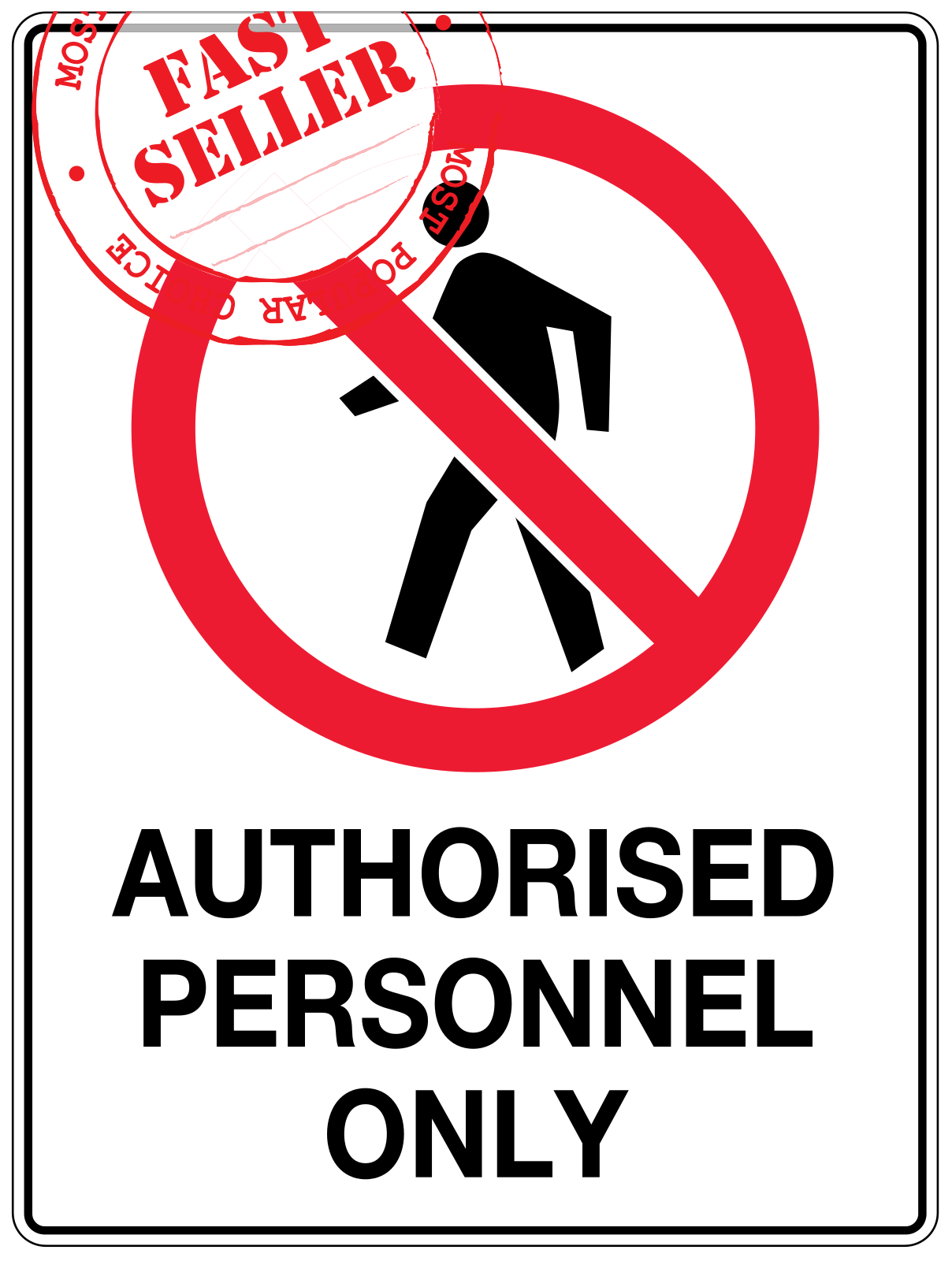
Prohibition
Browse prohibition signs →- Shape / colour
- Red circle with diagonal slash on white background
- Purpose
- Indicates behaviour that is NOT permitted.
- Examples
- No Smoking, No Entry, No Food or Drink, No Mobile Phones.
- Wording
- Black text on white below the pictogram
Mandatory
Browse mandatory signs →- Shape / colour
- Solid blue circle with white pictogram
- Purpose
- Indicates behaviour that MUST be followed — typically PPE or a required action.
- Examples
- Hi-Vis Must Be Worn, Safety Boots Must Be Worn, Wash Your Hands, Hard Hat Area.
- Wording
- Black text on white below the pictogram
Warning
Browse warning signs →- Shape / colour
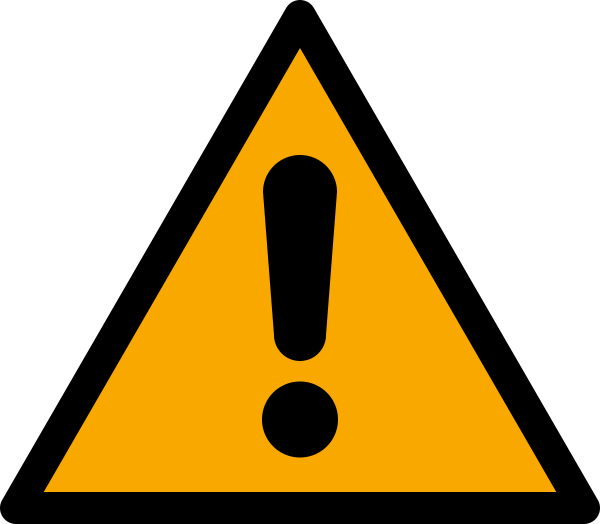
- Yellow triangle with black border and black pictogram
- Purpose
- Warns of a hazard or hazardous condition likely to cause harm if not avoided.
- Examples
- Slippery Surface, Forklifts Operating, Wet Floor, Overhead Hazard.
- Wording
- Black text on yellow below the triangle
Danger
Browse danger signs →- Shape / colour
- Red oval containing white 'DANGER' text, inside a black rectangle
- Purpose
- Warns of a hazard or condition likely to be LIFE-THREATENING if not avoided.
- Examples
- Danger High Voltage, Danger Keep Out, Danger Asbestos, Danger Confined Space.
- Wording
- Black text on white below the header

Emergency information
Browse emergency information signs →- Shape / colour
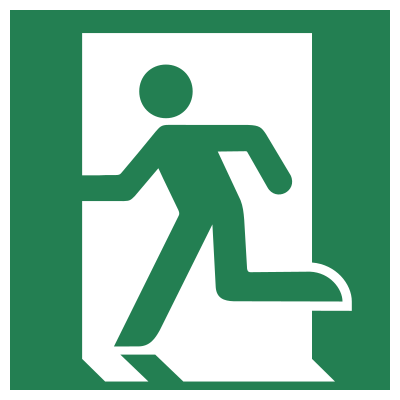
- Solid green square with white pictogram
- Purpose
- Indicates location of safety equipment, safe-condition devices, and evacuation / first-aid facilities.
- Examples
- First Aid, Emergency Eyewash, Emergency Shower, Assembly Point, Safety Exit.
- Wording
- White text on green below the pictogram

- Shape / colour
- Solid red square with white pictogram
- Purpose
- Indicates location of fire-fighting equipment, fire alarms, hose reels and extinguishers. Separate Standard (AS 2444) governs extinguisher selection and signage placement.
- Examples
- Fire Extinguisher, Fire Hose Reel, Fire Blanket, Fire Alarm Call Point.
- Wording
- White text on red below the pictogram
Choosing the right sign class
- Is the message telling someone NOT to do something? Use a Prohibition sign.
- Is it telling them they MUST do something (wear PPE, wash hands)? Use a Mandatory sign.
- Is it warning of a hazard likely to cause injury? Use a Warning sign.
- Is the hazard potentially life-threatening (electrocution, asphyxiation, crushing)? Use a Danger sign.
- Is it pointing to safety equipment, first aid, or a safe route? Use an Emergency Information sign.
- Is it identifying fire-fighting equipment? Use a Fire sign (and for extinguishers, cross-check against AS 2444 for placement).
Common mistakes to avoid
- Using the wrong colour-combination for custom text. Don’t combine red with yellow to create a “stronger warning” — it breaks the visual grammar and reduces comprehension for workers who rely on pattern-recognition at a distance.
- Replacing the ISO 7010 pictogram with a clip-art equivalent. Pictograms are part of what makes the sign internationally legible, including for workers with low English literacy.
- Mixing Warning and Danger incorrectly. A “Danger” header demands a life-threatening hazard. Using it for minor risks dilutes the signal.
- Printing at sub-spec contrast or font size. A sign that can’t be read at the approach distance it’s installed for is arguably no sign at all.
- Forgetting supplementary text. Most AS 1319 signs pair a pictogram with plain-English text directly below. Signs without text can be ambiguous in an industrial context.
Related Australian Standards
- ISO 7010 — the source of most AS 1319 pictograms; adopted internationally.
- AS/NZS 1906.1:2017 — retroreflective materials (used where the sign must be visible in low-light conditions).
- AS/NZS ISO 3864 series — graphical symbols, safety colours and safety signs (complements AS 1319 for the international conventions).
- AS 2444 — portable fire extinguishers and hose reels; governs selection and location, which in turn drives where extinguisher-location signs go.
- AS/NZS 2293 series — emergency escape lighting and exit signs; takes precedence over AS 1319 for exit signage.
- AS 1428.1 — design for access and mobility; governs tactile and braille signage for accessible toilets and exits.
Official references
- Standards Australia — AS 1319:1994 product page
- Safe Work Australia — model Work Health and Safety laws
- WorkSafe ACT — safety signs guidance
Frequently asked questions
Is AS 1319 mandatory in Australia?
AS 1319 is an Australian Standard, not a law. It is mandatory only where a specific Act, Regulation, Code of Practice, or contract incorporates it by reference — for example, some state WHS codes reference AS 1319 when specifying how workplace signs should be designed, and WorkSafe ACT describes AS 1319-1994 as the Australian Standard covering safety signs for work environments. In practice, following AS 1319 conventions is treated as good evidence of having discharged the general WHS duty to provide clear, effective safety information.
What is the difference between a Warning sign and a Danger sign under AS 1319?
Warning signs use a yellow triangle with a black border and warn of a hazard that is likely to cause injury if not avoided. Danger signs use a red oval reading 'DANGER' on a black-bordered rectangle and warn of a condition that is likely to be life-threatening if not avoided. The severity of the hazard determines which class you use — Danger is reserved for situations where exposure could kill.
Can I make my own AS 1319 signs?
Yes, provided the artwork follows the shape, colour, pictogram and wording conventions in the Standard. Many workplaces print or engrave site-specific text signs using an AS 1319-styled template. Buying from a signage manufacturer who uses the correct colours, symbols, fonts and materials is usually faster and more defensible when you need to show a WHS inspector that your signage was produced to a recognised convention.
Does AS 1319 cover fire exit signs?
AS 1319 covers fire-equipment signs (extinguishers, hose reels, fire blankets) under its 'Fire' class, but emergency exit signs are primarily governed by AS/NZS 2293 (emergency lighting and exit signs) and the National Construction Code Volume 1 Part E4. Photoluminescent wayguidance signs follow AS 4724.1. See our separate guides on those Standards for the detail.
What materials does AS 1319 require?
AS 1319 does not specify a single material. It specifies colour, shape, symbol, wording and legibility requirements. Material choice (corflute, polypropylene, metal, vinyl, ACM) depends on durability, location, UV exposure and installation method — an outdoor construction-site sign typically uses colorbond or polypropylene, while an indoor warehouse sign may use corflute or self-adhesive vinyl. Reflective versions for low-light use are governed by AS/NZS 1906.1.
Browse AS 1319-styled signs
We manufacture over 150 safety signs to the AS 1319 visual conventions, available in corflute, polypropylene, colorbond and vinyl with bulk discounts up to 40%.
Planning signage for a specific site? These interactive checklists bring together the sign families covered above alongside the rest of what the workplace typically needs.