
Emergency Exit & Photoluminescent Signs Australia
Exit signage in Australia is governed by the NCC (what's required, where), AS/NZS 2293 (the electrical exit sign Standard), and AS 4724.1 (photoluminescent wayguidance). This guide explains the three together — and where each applies.
Last reviewed:
The three frameworks
- National Construction Code Volume 1 Part E4 — Visibility in Emergency. Driveswhat signage a building needs and where. Varies by building class (Class 2 residential, Class 5 office, Class 6 retail, Class 7 warehouse, Class 9 assembly / healthcare, etc.). Maintained by the Australian Building Codes Board.
- AS/NZS 2293 series. Covers design, installation, commissioning, inspection and maintenance of emergency escape lighting and exit signs. The exit signs themselves are electrical and remain illuminated during a power failure via battery backup.
- AS 4724.1. Covers photoluminescent safety wayguidance systems — self-luminous glow signs that absorb ambient light and emit visible light in darkness. Typically used as secondary wayguidance to supplement AS/NZS 2293 electrical systems.
Electrical exit signs (AS/NZS 2293)
An AS/NZS 2293 exit sign is an electrical luminaire with a battery backup. When mains power fails, the sign continues to display for the minimum duration set in the Standard (typically 90 minutes for self-contained systems). Key design rules:
- Must display the prescribed pictogram (running-man) at the correct aspect ratio
- Must be visible along the path of travel to every required exit
- Viewing distance determines the sign size — the Standard specifies ratios between pictogram height and maximum viewing distance
- Must be tested and serviced per AS/NZS 2293.2 (typically six-monthly discharge tests)
- Installation and commissioning records are required for building certification
Photoluminescent wayguidance (AS 4724.1)
Photoluminescent signs are not powered and need no wiring. They charge under normal room lighting and emit light during a blackout. AS 4724.1 sets the minimum luminance performance over time (initial brightness and decay) and governs the quality of materials used.
Typical applications:
- Low-level wayguidance along corridor skirting and stairwell handrails
- Floor-mounted exit identification discs
- Stair-nosing identification (for stair tread edges)
- Exit door identification at low level (complementing overhead AS/NZS 2293 signs)
- Primary exit signage in buildings where the NCC does not require an AS/NZS 2293 system
Related AS 1319 emergency-information signs
Beyond the exit pictogram itself, a complete emergency-signage package usually includes AS 1319 Emergency Information class signs (green background, white pictogram):
- Emergency Assembly Point
- First Aid Station
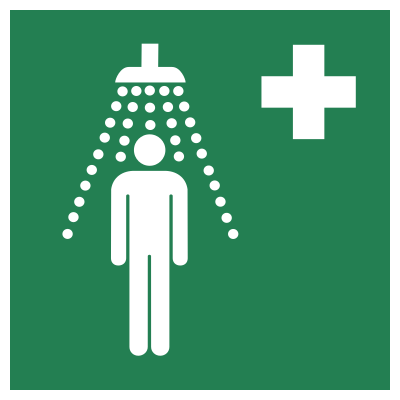
- Emergency Shower
- Emergency Eyewash
- Safety Exit (where further directional signage is needed past the NCC-required exit)
- Disabled Refuge Point / Disabled Fire Exit
- Break Glass to Open (for mechanical emergency releases)
- Fire Brigade Block Plan (site-specific custom layout)
Product ranges we manufacture
Fire Exit Signs
Running-man exit pictograms, directional arrows, and door identification.


Emergency Signs
Assembly point, eyewash, emergency shower, first aid and evacuation signage.


Photoluminescent Signs
AS 4724.1-styled glow-in-the-dark wayguidance for stairwells, exits and floor markers.


Official references
- Standards Australia — AS/NZS 2293.1:2018 (Emergency escape lighting and exit signs — Design, installation and commissioning)
- Standards Australia — AS 4724.1 (Photoluminescent safety wayguidance systems)
- Australian Building Codes Board — National Construction Code
- Safe Work Australia — Emergency plans (WHS Reg 43)
Frequently asked questions
Can a photoluminescent exit sign replace an electrical exit sign?
Not in most Class 2-9 buildings. The National Construction Code requires electrical exit signs meeting AS/NZS 2293 in buildings that need an emergency lighting system — which is most commercial, industrial, retail, hospitality and residential buildings above small-scale. Photoluminescent signs under AS 4724.1 have a specific role: low-level wayguidance to supplement the electrical system, or primary signage in buildings where an emergency-lighting system is not required. Always check the building classification and the certifier's specification before substituting.
What is AS/NZS 2293?
AS/NZS 2293 is the Australian/New Zealand Standard series covering emergency escape lighting and exit signs. AS/NZS 2293.1:2018 covers design, installation and commissioning of emergency lighting and exit signage for buildings. AS/NZS 2293.2 covers inspection and maintenance. AS/NZS 2293.3 covers emergency luminaires and exit signs themselves. It is a primary referenced document in NCC 2022.
What is AS 4724.1?
AS 4724.1 covers photoluminescent safety wayguidance systems — the glow-in-the-dark signs and markings that guide building occupants along evacuation routes when power fails. It is typically used to supplement AS/NZS 2293 electrical systems, provide low-level wayguidance along corridors and stairwells, and identify exit doors and floor numbers at low level.
Where does NCC Part E4 fit in?
NCC Volume 1 Part E4 (Visibility in Emergency) sets the performance and deemed-to-satisfy requirements for emergency lighting and exit signs in Class 2-9 buildings. E4 references AS/NZS 2293 as the primary standard. Whether your building needs exit signs and emergency lighting, and what type, is driven by Part E4 + the building's classification (Class 2 apartments, Class 5 office, Class 6 retail, Class 7 warehouse, Class 9 healthcare/assembly etc.).
Is the running-man pictogram compulsory?
The running-man pictogram (ISO 7010 E001 / E002) is the modern and internationally recognised exit sign symbol. AS/NZS 2293 permits the running-man symbol on exit signs, and it is now the dominant format specified in new-build projects. Older 'EXIT' text-only signs remain installed in many buildings and are not automatically non-compliant, but the running-man pictogram is generally preferred by certifiers because it is language-independent and matches international convention.
Do I need an assembly point sign?
Most workplaces with a formal evacuation plan nominate an external assembly point and mark it with an AS 1319 Emergency Information (green) sign. While the model WHS Regulations do not prescribe a specific sign, identifying the assembly point in physical signage is standard practice and supports discharge of the PCBU's emergency-plan duties under WHS Reg 43.
Exit & emergency sign packs
Running-man exit pictograms, directional arrows, disabled refuge signs, assembly point signs, and AS 4724.1 photoluminescent wayguidance. Custom fire brigade block plans available.
Planning signage for a specific site? These interactive checklists bring together the sign families covered above alongside the rest of what the workplace typically needs.